Learn 5e: how to play, from your first roll to your first character
A beginner's tutorial for 5th Edition fantasy roleplaying. No rulebooks needed: everything here comes from the free core rules, and you can read it in about fifteen minutes.
What this game is
It's a game of telling a story together. One person, the Dungeon Master (DM), describes the world and plays everyone in it: the innkeeper, the villain, the dragon. Every other player controls one character, a hero they make up, and decides what that character says and does.
The DM describes a situation. You say what your character does. The DM tells you what happens, and when the outcome is uncertain, the dice decide. That's the whole loop.
- There's no board and no winning. The goal is a good story, and failure often makes a better one.
- You can try anything. Talk your way past the guard, climb the wall, or start a fight. The rules are there to settle what happens.
- Most games mix three things: exploration (travelling, searching, solving puzzles), social scenes (talking, bargaining, lying) and combat.
An AI Dungeon Master plays the same role: it describes the world, plays the people you meet and tells you when to roll.
The dice
The game uses seven kinds of dice, written as "d" plus the number of sides: d4, d6, d8, d10, d12 and d20, plus a second d10 for percentages. "2d6" means roll two six-sided dice and add them; "1d8 + 3" means roll one eight-sided die and add 3.
The d20 is the important one: it decides whether you succeed. The others mostly decide how much: how much damage a sword does, or how much a potion heals. Online, you don't need real dice: the site rolls for you, with your bonuses already added.
The one rule: the d20 roll
Almost every uncertain thing works the same way:
The target is the Difficulty Class (DC) for most things (around 10 for easy, 15 for medium, 20 for hard) or the target's Armor Class (AC) when you attack.
Advantage and disadvantage: when the situation helps you (attacking an enemy who can't see you), you roll two d20s and keep the higher. When it hinders you (shooting in the dark), you roll two and keep the lower.
Ability scores and modifiers
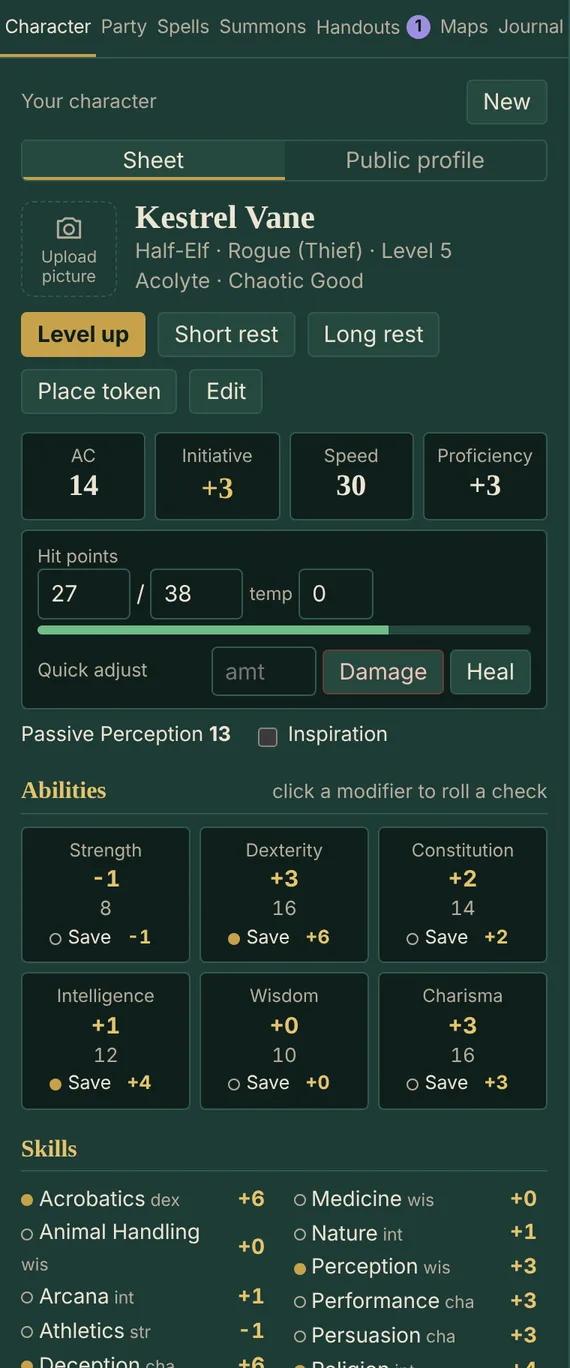
Every character has six ability scores, usually between 8 and 18 for a new character. Each one gives a modifier that you add to rolls:
- Strength (STR)
- Lifting, climbing, hitting hard with heavy weapons.
- Dexterity (DEX)
- Agility, reflexes, sneaking, bows and light weapons, and dodging (your AC).
- Constitution (CON)
- Toughness and stamina; it adds to your hit points.
- Intelligence (INT)
- Memory, reasoning, knowledge; wizards cast with it.
- Wisdom (WIS)
- Noticing things, intuition, willpower; clerics, druids and rangers cast with it.
- Charisma (CHA)
- Force of personality: persuading, lying, performing; bards, paladins, sorcerers and warlocks cast with it.
The modifier is the score minus 10, divided by 2, rounded down. So a 14 gives +2, and an 8 gives −1:
| Score | 1 | 2–3 | 4–5 | 6–7 | 8–9 | 10–11 | 12–13 | 14–15 | 16–17 | 18–19 | 20 |
|---|---|---|---|---|---|---|---|---|---|---|---|
| Modifier | −5 | −4 | −3 | −2 | −1 | +0 | +1 | +2 | +3 | +4 | +5 |
Skills, proficiency and saving throws
Skills are specific uses of an ability: Athletics (STR), Acrobatics and Stealth (DEX), Arcana and History (INT), Perception and Insight (WIS), Persuasion and Deception (CHA), and a few more. When you're proficient in a skill (trained in it, from your class or background), you add your proficiency bonus, which is +2 at 1st level and grows as you level up.
Saving throws are rolls to resist something done to you: a Dexterity save to dive away from a fireball, a Constitution save against poison, a Wisdom save against a charm. Each class is proficient in two kinds of save.
Make your first character
The Talewrite character builder goes through these steps in order, explains each choice and does all the arithmetic. Here's what each step means:
- Basics. A name, and which rules your table uses: 2014 (the classic 5th Edition) or 2024 (the revised version). Ask your table which one if you're not sure.
- Ancestry (called race in the 2014 rules and species in 2024). Human, elf, dwarf, halfling, dragonborn, gnome, tiefling and more. It gives traits like darkvision or extra speed. In the 2014 rules it also raises some ability scores.
- Class. The biggest choice: what your character does. See picking a class below.
- Abilities. Set your six scores. The easiest way is the standard array: 15, 14, 13, 12, 10 and 8, placed wherever you like. Put the highest in your class's main ability, and Constitution second or third. You can also use point buy, roll 4d6 for each, or type in scores your DM gave you.
- Background. What your character did before adventuring: acolyte, criminal, sage, soldier and so on. It gives two skill proficiencies and some gear. In the 2024 rules it also raises your ability scores.
- Languages. Everyone speaks Common, plus one or more others such as Elvish or Dwarvish. Characters who don't know a language can't understand it at the table.
- Skills. Pick the skills your class lets you train in. Choose ones that use your best abilities.
- Equipment. Take your class and background's starting kit (easiest), or roll starting gold and shop.
- Spells (spellcasters only). Pick your cantrips and 1st-level spells. If unsure, take one damage spell, one defensive or healing spell, and one useful one.
- Review. Check it over, add a short backstory and personality, and create. Hit points, armor class, attacks and spell slots are filled in for you.
Picking a class
There's no wrong choice, but some classes have more to keep track of than others. If you can't decide, a fighter, barbarian or rogue is a gentle start, and a cleric is the friendliest spellcaster.
| Class | Plays like | Main ability | Complexity |
|---|---|---|---|
| Barbarian | A tough front-line warrior who flies into a rage, shrugging off blows. | Strength | Easy |
| Bard | A performer whose music is magic: helps friends, hinders foes, good at talking and skills. | Charisma | Medium |
| Cleric | A priest with divine magic: heals, protects and wears armor. | Wisdom | Medium |
| Druid | A keeper of nature who casts nature magic and can turn into animals. | Wisdom | Harder |
| Fighter | A trained warrior with the best weapons and armor and few things to track. | Strength or Dexterity | Easiest |
| Monk | A fast martial artist who fights with fists and feet. | Dexterity and Wisdom | Medium |
| Paladin | A holy knight: heavy armor, healing touch and smiting blows. | Strength and Charisma | Easy |
| Ranger | A hunter and tracker, at home in the wild and deadly with a bow. | Dexterity and Wisdom | Medium |
| Rogue | A sneaky expert: lots of skills, and big damage when striking by surprise. | Dexterity | Easy |
| Sorcerer | Born with magic in the blood, able to bend spells as they cast them. | Charisma | Medium |
| Warlock | Gets magic from a pact with a powerful being; few spells, but they come back quickly. | Charisma | Medium |
| Wizard | A scholar of magic with the biggest spell list in the game. | Intelligence | Harder |
Each class also chooses a subclass (a specialty, such as a fighter becoming a Champion) at 1st to 3rd level, depending on the class and edition. Besides the official ones, Talewrite has 24 original subclasses of its own, two for every class.
Playing a scene
Most of the game is simply saying what your character does. Be specific about your goal and your approach, and let the DM ask for a roll if one is needed:
You: "Mira leans on the counter and smiles. 'We both know nobody else in this town wants it. Thirty, and I'll tell you who's been asking about you.'"
The DM: "Make a Charisma (Persuasion) check."
You don't need to know which skill applies: describe what you do, and the DM picks the roll. You also don't roll for things that can't fail or can't succeed: walking through an open door needs no roll, and nobody can jump to the moon.
Talking in character (in your character's voice) is encouraged but never required. "I try to convince him to lower the price" works just as well.
Combat
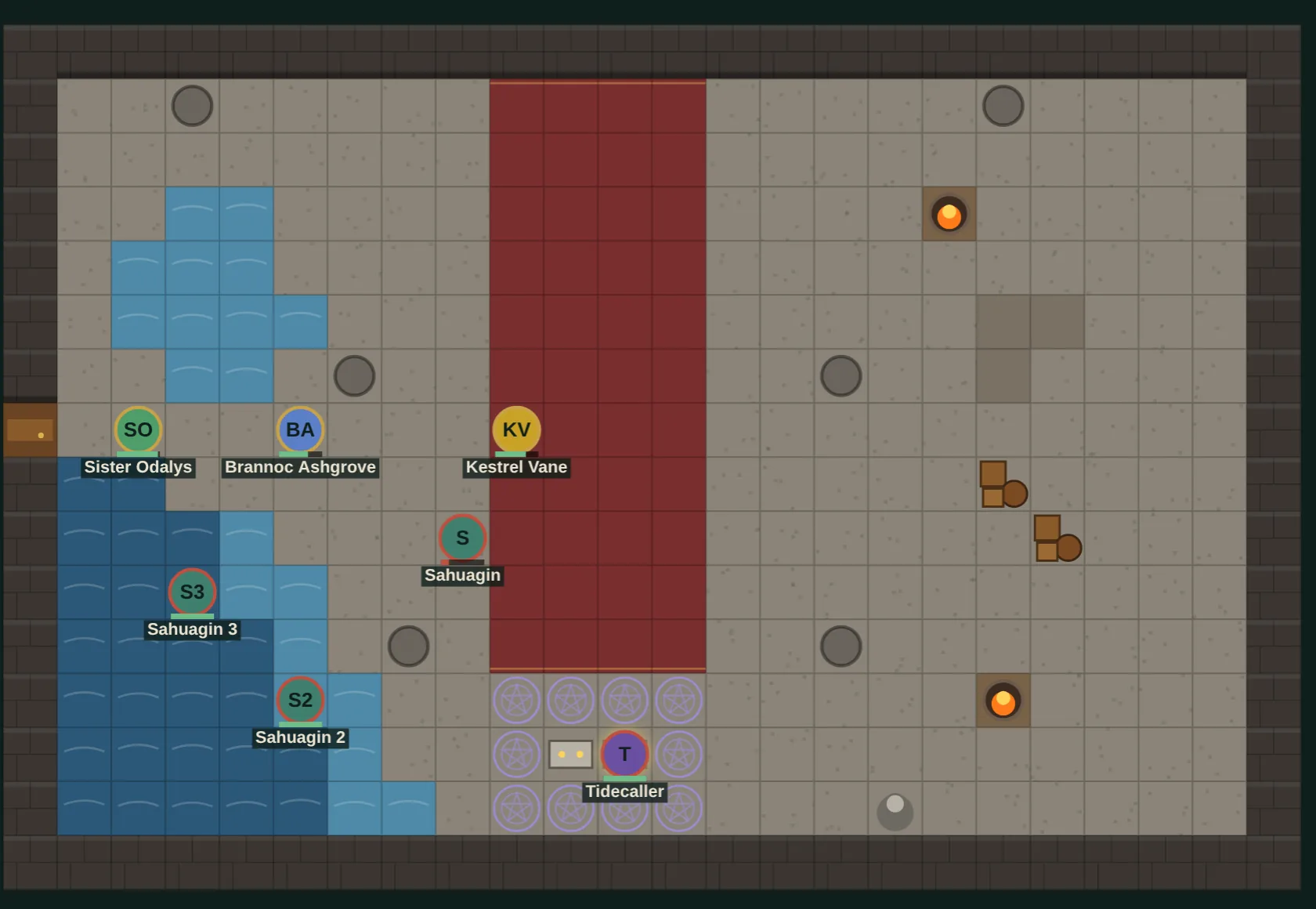
When a fight starts, everyone rolls initiative (a Dexterity check) to set the order. Then each creature takes a turn. A round is everyone taking one turn, about six seconds in the story.
On your turn you can:
- Move up to your speed (usually 30 feet), and split it up before and after other things.
- Take one action: usually Attack or cast a spell. Others include Dash (move again), Disengage (move away safely), Dodge (attacks against you have disadvantage), Help (give an ally advantage), Hide, and using an object.
- Take a bonus action, if something you have says it uses one (like a rogue's Cunning Action or some spells).
- Talk: a short shout or a few words is free.
You also get one reaction each round, used even outside your turn. The most common is an opportunity attack: when an enemy moves out of your reach, you can make one attack against it.
Attacking: roll a d20 + your attack bonus (shown on your sheet) against the target's AC. If you hit, roll the weapon's damage dice + your modifier. A natural 20 is a critical hit: roll the damage dice twice.
Casting spells
- Cantrips are small spells you can cast as often as you like, such as a bolt of fire or a magic light.
- Spells of 1st level and higher use a spell slot. You have a few slots of each level, and they come back when you rest (a long rest for most casters; warlocks get theirs back on a short rest).
- Attack spells use an attack roll like a weapon. Save spells make the target roll a saving throw against your spell save DC (8 + your proficiency bonus + your casting ability modifier).
- Concentration: some spells last as long as you concentrate. You can only concentrate on one at a time, and taking damage forces a Constitution save to keep it going.
Look up any spell in the free spell list (2024 rules) or the 2014 spell list.
Hit points, dying and resting
Damage lowers your hit points. Healing spells, potions and rest bring them back. When you drop to 0 hit points, you fall unconscious and start making death saving throws at the start of each of your turns:
- Roll a d20 with no modifiers. 10 or higher is a success, below 10 is a failure.
- Three successes and you stabilise. Three failures and your character dies.
- A natural 20 brings you back with 1 hit point. A natural 1 counts as two failures.
- Any healing gets you back on your feet at once, so your friends can save you.
Resting: a short rest (about an hour) lets you spend Hit Dice to heal and recharges some abilities. A long rest (a night's sleep) restores your hit points and spell slots.
Leveling up
Characters start at 1st level and grow as the story goes on, either by earning experience points (XP) or when the DM says so ("milestones"). Each level gives more hit points and new features; spellcasters get more and stronger spells. At 4th level and every few levels after, you raise your ability scores or take a feat (a special talent). On Talewrite, level-up walks you through each new choice.
Glossary
- AC (Armor Class)
- How hard you are to hit. An attack has to meet or beat it.
- DC (Difficulty Class)
- The target number for a check or saving throw, set by the DM or the spell.
- Check
- A d20 roll to see if you succeed at something uncertain: d20 + ability modifier (+ proficiency if you're proficient in the skill).
- Saving throw ("save")
- A d20 roll to resist something bad happening to you, like a spell or a trap.
- Modifier
- The bonus or penalty that comes from an ability score, added to rolls.
- Proficiency bonus
- An extra bonus (+2 at 1st level) on the things your character is trained in.
- Advantage / disadvantage
- Roll two d20s and keep the higher (advantage) or lower (disadvantage).
- HP (hit points)
- How much harm you can take. At 0 you fall unconscious.
- Initiative
- A Dexterity roll at the start of a fight that sets the turn order.
- Spell slot
- The "fuel" for casting a spell of 1st level or higher. Slots come back when you rest.
- Cantrip
- A minor spell you can cast as often as you like.
- Concentration
- Some spells last only while you focus on them; you can concentrate on one at a time, and taking damage can break it.
- Short rest / long rest
- About an hour (short) or a night's sleep (long) to recover hit points, spell slots and abilities.
- NPC
- A non-player character: anyone in the world played by the DM.
- Natural 20 / natural 1
- Rolling a 20 or a 1 on the die itself. On an attack, a natural 20 is a critical hit and a natural 1 always misses.
What next
- Play the free practice game to try posting, rolling and a small fight in about ten minutes.
- Build a character with the builder, using the steps above.
- Find a table in the Lobby, invite friends, or start a game with the AI Dungeon Master.
Read How to play on Talewrite for how the site itself works: the table screen, writing a good post, whispering to the DM and more.
Rules summarised from the System Reference Documents 5.1 and 5.2 by Wizards of the Coast LLC, licensed under CC-BY-4.0. Talewrite is not affiliated with or endorsed by Wizards of the Coast.